
Jesus, Our "Eucatastrophe," Our Happy Ending
Our story begins and ends with Joy.

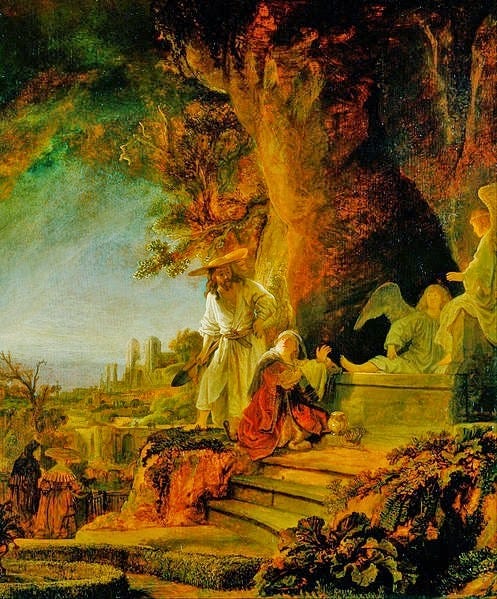
(Christ and Saint Mary Magdalene At The Tomb By Rembrandt)
O wonder of your humble care for us!
O love, O charity beyond all telling,
to ransom a slave you gave away your Son!
O truly necessary sin of Adam,
destroyed completely by the Death of Christ!
O happy fault
that earned so great, so glorious a Redeemer!O truly blessed night,
worthy alone to know the time and hour
when Christ rose from the underworld!This is the night
of which it is written:
The night shall be as bright as day,
dazzling is the night for me,
and full of gladness.
From “The Exsultet: The Proclamation of Easter”
(If you love The Lord of the Rings as much as I do, then you are probably well versed in “eucatastrophe.” If you are not, be prepared. For what you are about to read is a nerdy easter reflection. But hopefully a reflection that will bring you to deeper joy.)
JRR Tolkien coined and defined “eucatastrophe” as the opposite of a tragedy.1 Where a Drama ends in uncertain doom, like in Romeo and Juliet, a Fairy-Story takes a joyful turn for good when everything is hopeless. You see this happen over and over again in The Lord of the Rings. Fortunately the movies carry this theme effectively in the books. For example, when Gandalf and Eomer lead the Riders of Rohan to Helm’s Deep to rescue the defenders from the onslaught of Uruk-kai invaders. My favorite moment when this happens in The Fellowship of the Ring is in the 6 chapters that are neglected in the movies. You find the Hobbits experience the dread of the Nazgul’s pursuit, wild trees suffocation, or Barrow-wrights bringing them to certain doom but an unexpected hero (Farmer Maggot and Tom Bombadil) rescue them at the last moment.
However the principle example of “eucatastrophe” culminates in The Return of the King. Frodo and Samwise bring the evil One Ring of the Dark Lord Sauron to Mount Doom. The destruction of this ring in this volcano would mean the liberation of all Middle Earth but at the last moment, Frodo is finally corrupted by Sauron’s power in the Ring and refuses to destroy the One Ring. Yet Gollum is also there because he desires to have the Ring more than anything else. He is corrupted beyond redemption and acquires the Ring from Frodo by biting off Frodo’s finger. Frodo writhes in pain on the ground, a failed hero, and his antagonist begins to dance with joy. His dance inadvertently brings him off the cliff into the volcano and destroys the Ring. The freedom of Middle Earth comes because of Gollum’s “happy fall.”
As you read above, the middle of the Catholic Mass for Easter includes this phrase “Happy Fault,” which in Latin is Felix Culpa, and can also be translated as “Fortunate Fall” (as Kings Kaleidoscope chooses to), but in combination, you find the phrase “Happy Fall.” This isn’t a typical way of translating Felix Culpa but I find it fascinating that the redemption of Middle Earth comes through the joyful fall of Gollum and the redemption of humanity comes because of Adam’s fault. Frodo’s failure to destroy the ring, still leads to the joy of its destruction just as Adams failure would still led to the joy of God’s presence because of Christ.
I can’t help but see a marriage of the “Happy Fall” and the “Eucatastrophe” between Middle Earth and Scripture. Just how Frodo’s failure led to the liberation of Middle Earth, Adam’s failure led to the redemption of Christ. It seems to say that in all our attempts at self destruction, any sad thing that happens in our lives, and all evil we commit against our neighbor Christ’s power mysteriously redeems. This isn’t to say it’s a good thing that our sins, failures, brokenness and the abuses done to us. Rather Our brokenness becomes “happy”, or redeemed, because it eventually leads us to the ressurection of Christ. Our tragedies become eucatastrophes.
God redeems humanities brokenness all throughout the biblical narrative. For example, the story of Adam and Eve seems to end in a tragedy. They disobey God (they use the One Ring, if you will), are exiled from the Garden, and are forced to till the earth in its harsh elements. Yet that occurrence sets off a trajectory for redemption that culminates in Christ salvation. Or we see Joseph repeatedly experience abuse in his story. Yet God takes that abuse and makes it a catalyst for the good and redemption of himself, his brothers, and Egypt. The disobedience of Israel, the invasion of Babylon, and the destruction of the Temple also cannot stop God’s power to take tragedy and turn it to eucatastrophe. For in the midst of that trauma, God leads the Jewish people to a promised “happy ending” of a renewed creation through the Messiah.2
Tolkien writes that eucatastrophes are also ways for stories to point toward the Gospel. He proposes that the birth of Christ, is the eucatastrophe of humanity, the resurrection is the eucatastrophe of the incarnation, and Christ’s story is a story that begins and ends in joy. In the biblical narrative the Garden of Eden was creation’s first eucatastrophe, which would lead to a greater eucatastrophe in the resurrection of Christ, and ultimately to the eucatastrophe in His return. So as the biblical story begins and ends in joy, God promises that our story “begins and ends in joy” as all “falls” are transformed to “happy endings” by the power of God.
This does not dismiss the pain we still feel in the midst of the “Already, but not Yet.” Rather it’s an invitation to deeper trust, deeper hope, to fight against all despair, that Christ has redeemed all and he will restore all. That all humanities brokenness, whether falls and faults, is not the end of the story. The happy ending is here whether we see it or not. I imagine all our brokenness being met by Christ, our eucatastrophe, like Mary in the Garden tomb.3 Where at first we see graveyards, once we see Him, now we see gardens because he has utterly transformed our pain. Then like Mary, we declare with utter joy, “I have seen the Lord.”
So look to the eyes of Joy dear friends. Gaze into His loving eyes. Sieze His hands. For every failure of Adam has been met by the tender hands of Christ that hang on Calvary and has been met by God’s ressurrection power. The sin of Adam has been completely destroyed by Christ. Each and every sin we commit on this earth: completely destroyed by Christ! Each and every abuse we endure: completely destroyed by Christ! Each and every trauma we live: completely destroyed by Christ! And above all, the Happy Ending, the Eucastrophe, Jesus our King, is here and coming! “Is everything sad becoming untrue?” Take hold of Joy because He is making all things new! Everything Sad is becoming untrue!4
So with tenderness and hope, I write this knowing our pain feels fresh and I do not wish to dismiss what aches. But if I may, let this Easter reflection gaze your eyes into the eyes of Christ, even if your gaze lifts slowly. He is good and longs for you to see his kindness.
So to those who are experiencing or remembering the loss of loved ones today
Christ is Risen!
To those who are filled with despair,
All things sad will become untrue.
To those who are imprisoned unjustly in our nation by ICE and unjustly in the world.
“He (Christ) who was seated on the throne said, “I am making everything new!” (Rev. 21:5)
To those who are divided from their families and neighbors in light of our political chaos.
All division is completely destroyed through Christ
To all who long for his physical presence
He is coming soon!
To those who are trapped in tragedy
He is risen indeed!
And to everyone this Easter Morning,
“Turn your eyes upon Jesus
Look full in his wonderful face
And the things of the earth will grow strangely dim
In the Light of his Glory and Grace.”
Jesus, our eucatastrophe,
our happy ending,
is here.
See “On Fairy Stories” by Tolkien for any reference to “Eucatastrophe.” https://coolcalvary.com/wp-content/uploads/2018/10/on-fairy-stories1.pdf
See Genesis 2-3; 50:15-20; and Isaiah 42 NIV.
See John 20:11-18, NIV.
Samwise Gamgee jubilantly asks this when he sees Gandalf the White for the first time after the Ring is destroyed in The Return of the King.